We conducted two working bees in April to make up for no working bee in March.
We reinstating drip irrigation under the station on April 12th.
Our original watering system was destroyed when the old ramp, landing and stairs were demolished. Plants were struggling as no rainfall penetrates under the landing.
On April 19th we tweaked the watering system, put some new plants under the station landing and mulched the area.
Anita, Jennie and Chris got stuck into the pruning.
The whole embankment garden was tidied, cleaned and watered.
Friday, 22 April 2016
Saturday, 9 April 2016
Working bees April 2016
Due to popular demand, we will hold the next Stationeers working bee on
Tuesday, April 12th beginning at 9:30 am. We will concentrate on installing the
watering system plus litter collection. Thomas has created a rough diagram for
the watering system.The following Tuesday (19th), Jennie, Thomas, Ros and anyone
else who is free that morning is welcome to attend a second working bee to do
some planting and lay mulch under the station. Once again we will start at 9:30
am.
Cheers,
Ros
Tuesday, 16 February 2016
February 2016 Working Bee
February Working Bee
Only four people attended the working bee this morning: Roger, Ed, Thomas and Ros.One of the changes we noted was extensive die-back of Myoporum insulare ground cover. The photo was taken last year when the Myoporum had been indiscriminately sprayed with Roundup along the footpath edge but now the ground cover is uniformly brown over most of the embankment.The fact that the Myoporum was still green under the Peppercorn tree indicates that perhaps the latest damage is the result of heat or sun damage. However the plants are not completely dead and when the summer is over we will prune them severely with an aim to rejuvenating them.
Although we brought with us 15 plants to fill in the planting gaps along the station under-croft,the soil was so dry that we resisted planting until we can improve growing conditions in this part of the embankment.Without access to rainfall,the existing plants continue to struggle. Thomas measured the site to install a manual watering system with a timer that we can operate between working bees.
Monday, 14 December 2015
December Working Bee
The December working Bee will be on Tuesday, December 15th at 9:30 am. Meet at the tap in Pin Oak Crescent. Main tasks are watering and collecting litter. Hopefully we will finish before it gets too hot but wear a hat. All welcome. Just turn up and sign in if you wish to join us.
Ros
Ros
Thursday, 26 November 2015
November 2015 Working Bee
Six volunteers attended the working bee on Tuesday, November, 24th: Ros, Thomas, Jennie, Ed, Roger and Margaret N. Apologies from John and Ian. We were very fortunate with the weather, it being a sunny, still morning; the next day was hot and extremely windy. In addition to our usual cleaning, watering and weeding duties, we pulled up all the poplar suckers that we could see and replanted the Agave mexicana and planted a ground-cover succulent (not Pigface) in the area where the Pigface was wiped out by a mealy bug infestation.
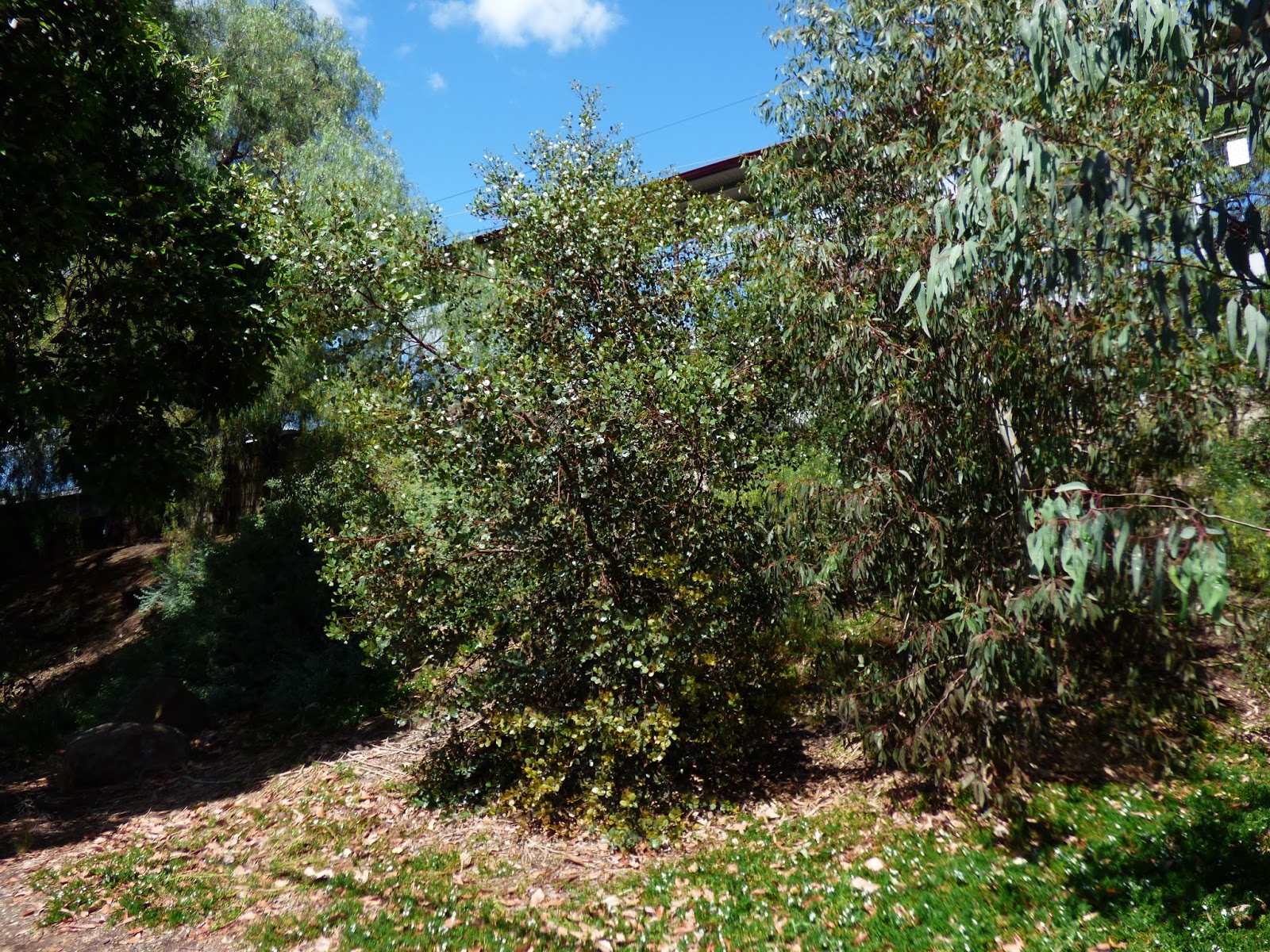
We were overjoyed to find the Eucalyptus platypus, (pictured) in flower for the first time since we planted it as a tiny tube stock five and a half years ago.Eucalyptus platypus, common name:"Round-leafed Moort"is a mallee. It grows 3-8 meters high and is densely foliaged to the ground. It is frost and drought resistant and is tolerant of alkaline soils and smog. I love the unusual shape and texture of the leaves as well as the pompom configuration of the flowers.
The last working bee for 2015 will be held in December; either 15th or 22nd...Stationeers are very busy around that time so we will need to compare diaries. Keep you posted,
Ros
Friday, 13 November 2015
November Working Bee
Our next working bee is scheduled for Tuesday, November 24th, 2015. Meet at the tap in Pin Oak Crescent at 9:30 am. Newcomers welcome. Just turn up and register to become a Stationeer.
Tasks will include cleaning up under the landing and steps, picking up litter from the whole area and watering. There has been some damage to the Agave mexicana nearest the step and the Pig-face has completely died around it. I will bring some replacement plants. Ros
Tuesday, 27 October 2015
October 2015 Working Bee Report
Six Stationeers attended a working bee on Tuesday October 21st. We were pleased to find the garden generally looking rather good despite
the soil being very dry. We weeded, pruned, watered and picked up rubbish ready for the "Off Tracks" Street Festival the following Sunday.
One seasonal change of note was the contrasting textures of the native grasses; Feather spear-grass living up to its name, forming a fluffy band at the base of the steepest section. This is very pleasing as the original Spear grasses we planted seemed to have only an annual lifespan but seeds of the original plants germinated where they found conditions favorable. The occasional bloom of Sticky Everlasting paper daisies, pale blue Tufted Bluebells and one Bulbine Lily plus pale pink Pelargonium australe quietly flowering among the Lomandra make the garden more than a pragmatic green-fill.
Under the station, lilies were in flower despite their absolutely awful growing conditions. We observed a native Blue-banded bee shaking pollen from the flowers of Dianella tasmanica with the vibration of its wings, a wonderful sight as we always hoped to attract native wildlife to the garden.
One seasonal change of note was the contrasting textures of the native grasses; Feather spear-grass living up to its name, forming a fluffy band at the base of the steepest section. This is very pleasing as the original Spear grasses we planted seemed to have only an annual lifespan but seeds of the original plants germinated where they found conditions favorable. The occasional bloom of Sticky Everlasting paper daisies, pale blue Tufted Bluebells and one Bulbine Lily plus pale pink Pelargonium australe quietly flowering among the Lomandra make the garden more than a pragmatic green-fill.
Under the station, lilies were in flower despite their absolutely awful growing conditions. We observed a native Blue-banded bee shaking pollen from the flowers of Dianella tasmanica with the vibration of its wings, a wonderful sight as we always hoped to attract native wildlife to the garden.
Subscribe to:
Posts (Atom)